Quick takeaways
- AI is already useful in radiology, especially for triage, detection, and workflow support.
- Replacing radiologists is harder than recognizing one abnormality on one image.
- The job may shift toward oversight, complex cases, communication, and accountability.
- The real risk is slower and more awkward: the job changes, and some radiologists adapt faster than others.
Why radiology became the target
Radiology was always going to be the specialty people pointed to first. The work is digital, image-heavy, and pattern-based. When deep learning started beating old image-recognition benchmarks, a lot of people assumed radiologists were next.
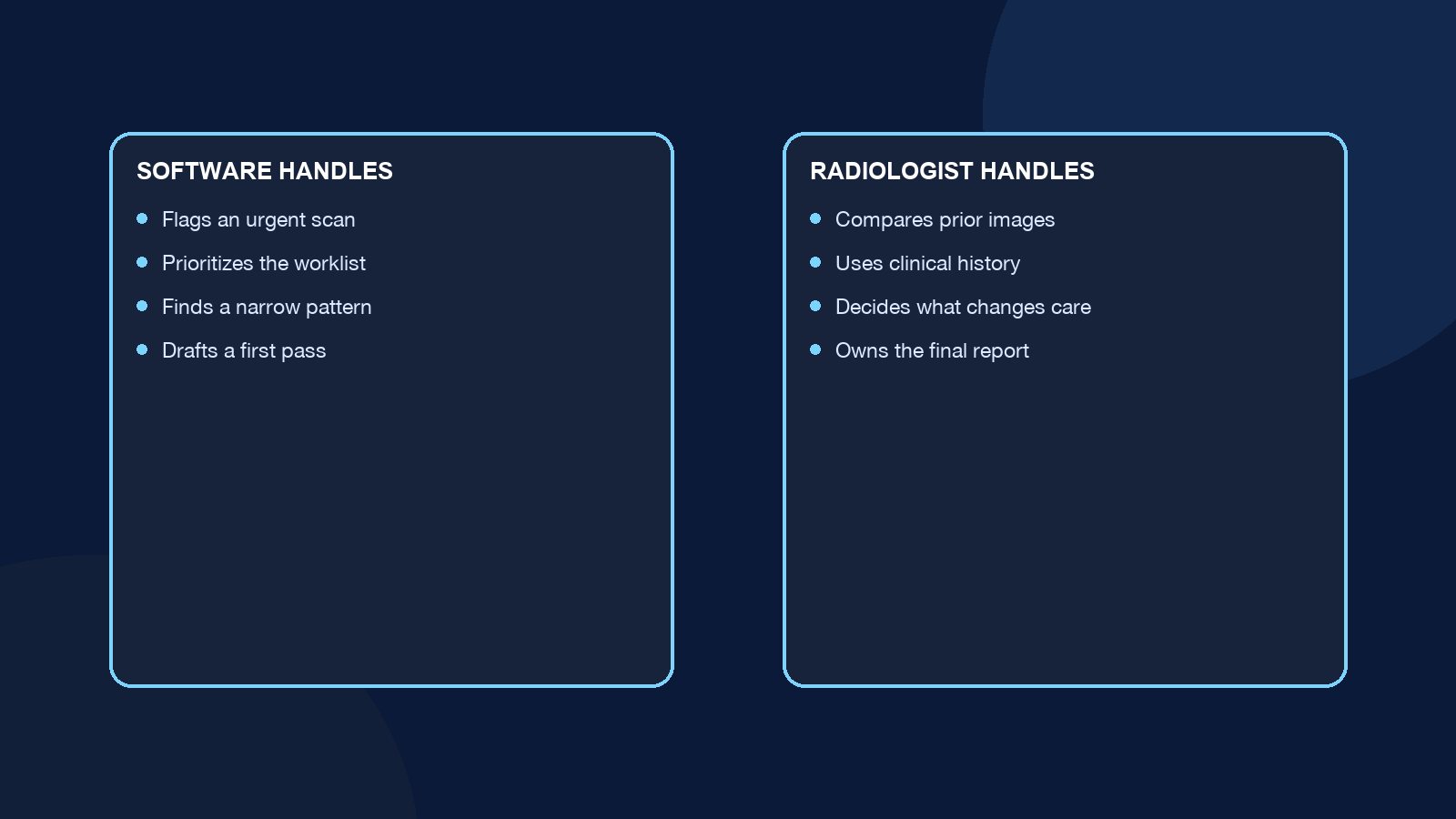
That prediction reduced radiology to spotting a white mark on a scan. Radiologists compare earlier images, use the clinical history and decide which finding changes care. They also take responsibility for the report.
AI is already changing the workflow
The most realistic AI tools right now do focused jobs such as flagging a possible stroke, prioritizing a chest X-ray or detecting a lung nodule. Each task covers only part of a radiologist's work.
A major review in Nature Medicine argued that high-performance medicine will come from humans and AI working together rather than one simply replacing the other (Topol). Radiology is probably the cleanest example of that idea.
Replacement is an economics question too
Hospitals still need a person responsible when the model misses something. Radiologists also explain uncertain findings to surgeons, judge scan quality and catch cases outside a model's training data.
I expect pressure to use AI to read more scans with fewer people. It can change staffing and speed expectations even if hospitals continue employing radiologists.
What the replacement headline misses
A chest CT may contain a lung finding, an old fracture and something unexpected in the abdomen. A narrow model may be excellent at one of those jobs. The radiologist has to decide which findings belong in the report and which one changes care today.
The job also includes talking. A surgeon may call to ask where a mass touches a blood vessel. An emergency physician may need an answer before the final report is finished. Those conversations are hard to count in an image benchmark, but they are part of why the scan was ordered.
I do expect staffing pressure. If AI speeds routine reads, a hospital may raise the expected volume instead of giving radiologists more time for difficult cases. That choice comes from administrators and deserves as much attention as the model's accuracy.
My Thoughts
I expect AI to change the job gradually. Routine reads will become more automated, leaving radiologists with more complicated cases and more responsibility for the model's output.
I think the radiologist who becomes more valuable will know when to use the tool, when to question it and how to explain the result to another doctor.