Quick takeaways
- A prospective trial tested AI that independently cleared low-risk breast-screening examinations.
- The AI pathway reduced radiologist workload by 63.6% and detected more cancers.
- Recall rates increased overall, which can mean more testing and anxiety.
- The results support partial automation in a specific workflow, not unsupervised AI across medicine.
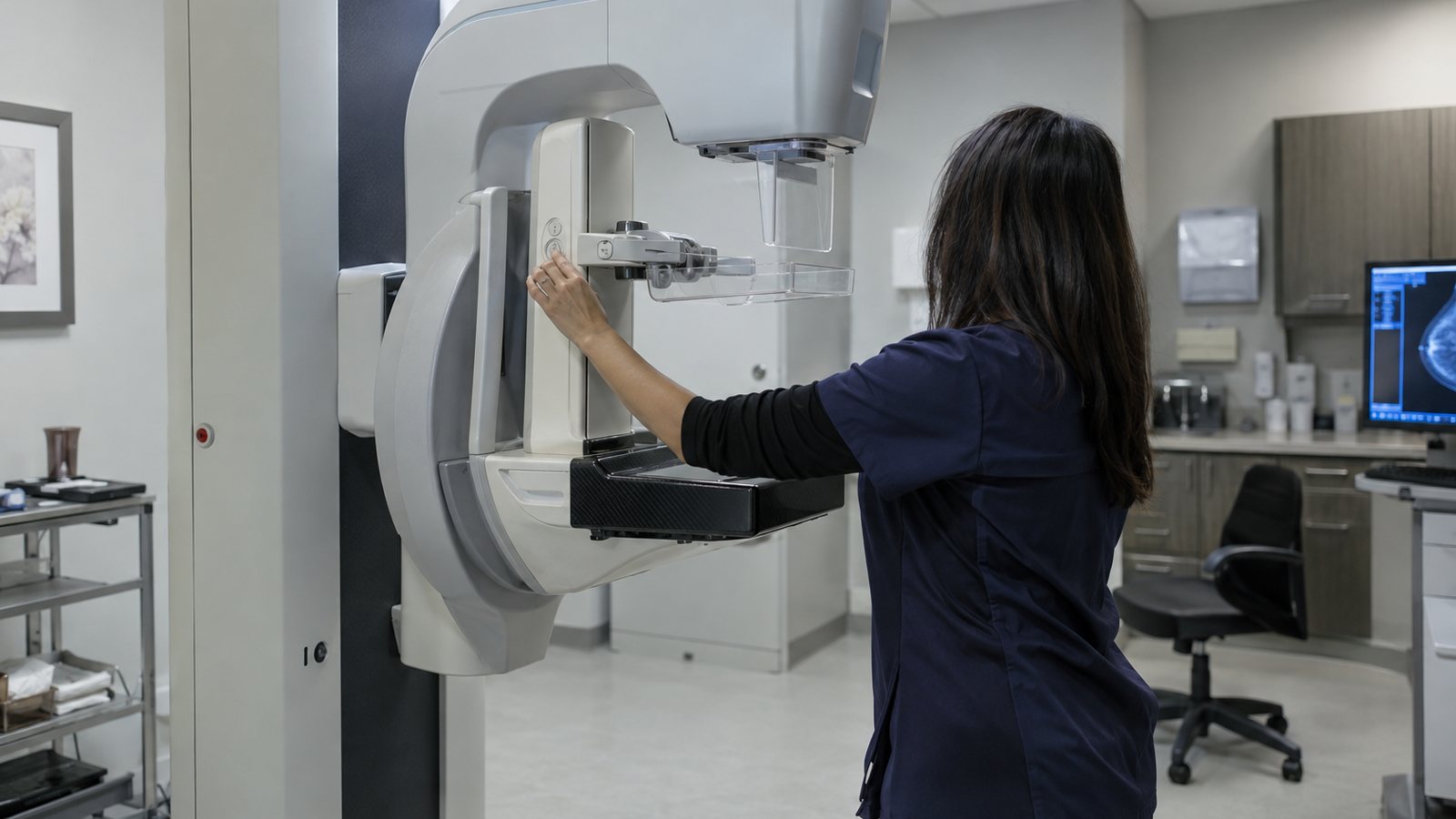
A new mammography trial gave AI a specific job that usually belongs to a radiologist. The system independently cleared examinations it considered low risk, so a radiologist never read those particular scans.
The trial ran inside a screening program. Most images in that setting are normal, so safely clearing low-risk scans could remove a large amount of reading work.
How the trial worked
The prospective study included 31,301 women in Córdoba, Spain. Every examination went through two strategies in parallel. The standard strategy used two independent human readers. The AI strategy treated low-risk examinations as normal without human review, while higher-risk studies were double read with AI support (Elías-Cabot et al.).
This was a noninferiority trial. The researchers were asking whether the partially autonomous approach could cut workload without producing unacceptably worse cancer detection or recall performance.
The workload result was hard to ignore
Radiologist workload fell by 63.6%, a reduction large enough to change staffing needs in a busy screening program. The cancer-detection rate also increased from 6.3 to 7.3 cancers per 1,000 examinations, a 15.2% relative increase.
The model’s narrow assignment probably helped. Screening mammography is repetitive, the possible next steps are defined and the program already has quality controls. The AI only had to sort scans into a large low-risk group and send the rest to closer review. It did not need to understand a patient's medical history.
More detection came with more recalls
The recall rate was 14.8% higher overall under the AI strategy. A recall sends a patient for more imaging or evaluation even though most recalled patients will not have cancer. That can bring days of uncertainty and sometimes an unnecessary biopsy.
The result also depended on the machine. Detection and recall stayed more stable with digital breast tomosynthesis. Ordinary digital mammography produced larger increases in both. A hospital cannot assume the same AI threshold will behave identically on each type of scan.
What autonomy should require
If AI is going to clear a scan without human reading, its performance needs to be monitored after deployment. Screening populations change. Hardware changes. Cancer prevalence and image quality differ between hospitals. A threshold that works in Córdoba may need adjustment somewhere else.
Patients also deserve a clear explanation of the process. Some may be comfortable knowing that their examination was classified as low risk by a validated system. Others may expect a person to look at every image. That is a real consent and trust question, especially when autonomy is introduced mainly to save time.
My Thoughts
This is one of the strongest cases I have seen for giving medical AI a defined piece of the workflow. Workload fell 63.6%, and the study reported both the higher cancer-detection rate and the higher recall rate.
Calling this replacement would be inaccurate. Radiologists still handled higher-risk cases, follow-up and quality control, and they remained responsible when the system failed. Their attention became more concentrated. I would judge that change by how carefully programs track cancers and recalls alongside the efficiency number.