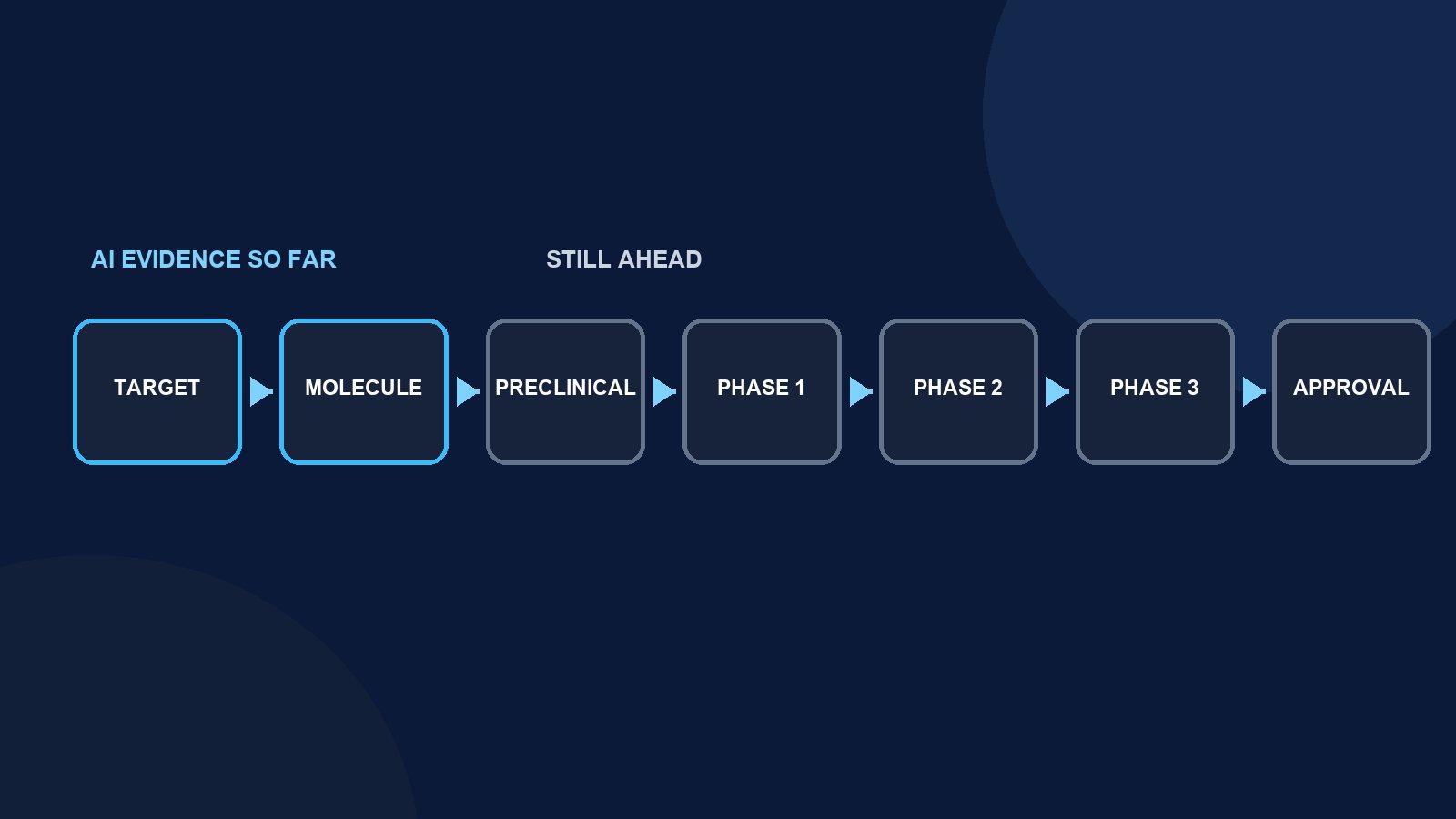
Quick takeaways
- AI can speed up parts of drug discovery, especially pattern-finding and protein work.
- A promising molecule still has to pass chemistry and years of human testing.
- The hype gets weaker when the question changes from discovery to an approved medicine.
Drug discovery takes years because most ideas fail. A molecule can look great in a computer model and die in a dish. It can work in animals and turn out to be useless or unsafe in people. By the time one drug reaches a pharmacy, researchers may have abandoned thousands of candidates.
Finding dead ends earlier is a believable use of AI. A faster search does not guarantee that a treatment succeeds in human trials.
AlphaFold2 showed why researchers were excited. Given a protein's amino-acid sequence, it could predict a likely three-dimensional structure with accuracy that shocked people in the field. DeepMind later released more than 200 million predicted structures. A question that could require months of lab work now had a useful computational starting point.
I remember reading the “protein-folding problem solved” headlines and assuming a drug would follow soon. Structural prediction is only one part of that process.
But a protein's shape is only a starting point. It does not show how to make a molecule bind safely, how that molecule will behave in a living system or whether side effects will appear years later.
Insilico Medicine used its software to choose a biological target and help design a pulmonary-fibrosis drug that reached human testing. Recursion takes a different approach, using images of treated cells to look for patterns across huge experiments. These tools can narrow the search. Researchers still have to make the compound and prove that it does something useful in a body.
So far, the strongest case for AI is near the beginning of the process. It can suggest targets and discard obvious failures before a team spends years on them. Human trials still take time because side effects may be rare and a real benefit may take months to measure. Software cannot hurry that evidence without weakening it.
I also worry the enthusiasm is ahead of the evidence. Several AI-designed compounds have entered trials and failed. That is normal in drug development, but it leaves open whether AI screening predicts clinical success any better than it predicts early lab results.
AI is already useful in the search phase. I want to see whether AI-selected drugs succeed in late trials more often than ordinary candidates before giving it more credit.
The comparison I want to see
Companies often announce how quickly a target or molecule was found. I would rather see AI-assisted candidates compared with ordinary candidates across the whole pipeline, including the shares that enter trials, fail for toxicity and show a useful effect.
That comparison will take years, which is inconvenient for a fast-moving AI story. It is still the only way to know whether the software improved drug discovery or simply produced more candidates sooner.
Rentosertib gives the field one real case to follow. Its next trials will tell us more than another list of molecules a model generated.